Redoubt Volcano - 04/21/1990 Photographer J Warren USGS
Government Agencies do not endorse websites

TAMBORA ERUPTION - 1815
Bird's Eye View
VIEW FROM NORTH LOOKING TOWARD ECLIPTIC PLANE
Saturn, Uranus and Jupiter complete a strikingly symmetric pattern with two ecliptic stars at the time of the explosive 1815 Tambora volcanic eruption!

Cleveland Volcano - Aleutian Islands - May 2006
ISS JN Williams - NASA

TAMBORA ERUPTION
THREE-DIMENSIONAL VIEW
There are two very powerful stars outside the Sun-Earth or ecliptic plane - Achernar in the southern hemisphere and Deneb in the North.
When angular separations with these two stars are considered, the approximate 64/116 pattern is reinforced!
Both Jupiter and Saturn are at points which could be considered "three dimensional!"

Kanaga Volcano ISS005-E-10097 ISS Aug 2002
Image Courtesy Image Science & Analysis Lab - NASA JSC


ERUPTION OF KUWAE
1452-53 AD
In late 1452 or early 1453 AD, a spectacular eruption occurred in the Vanuatu Islands of the South Pacific, north of New Zealand. In volume of total vented material, it probably surpassed the Tambora cataclysm of 1815!
For this episode in volcanic history, please note the angular similarity of Uranus and Neptune with the Antares-Aldebaran backbone of the “K” structure. At matching angles of approximately 58 and 122 degrees, this pattern would have persisted for months, allowing energy from earth’s core and mantle to be funneled to the same spot in the earth’s crust- a volcano named Kuwae.
The second diagram shows Saturn opposite Alhena with roughly equal angles. This amounts to a highly structured “Triple K.”
Saturn, moving through the sky at about one degree per month, would have stayed in this mirror-image position for several months. In fact, the February 2, 1453 position shows an exact match for angle values- 148.6!
Furthermore, Jupiter is very close to exhibiting right angles with the backbone during this late December period.
<<Disclaimer regarding historical patterns>> Astronomy software uses mathematical formulas which can show incremental drift for historical dates. The Moon and small planets are not shown due to the large numbers of cycles involved going back 5 ½ centuries.
Here are the approximate number of cycles for the large planets starting at the year 2000 and going back to 1453: Jupiter- 46, Saturn- 19, Uranus- 6.5 and Neptune- 3.3.
Therefore, since the number of cycles is relatively small for Saturn, Uranus and Neptune, these values are dependable. The Jupiter position should be accurate also.

Kaguyak Volcano - Alaska C Nye - Photographer ADGGS
Neither ADGGS or USGS endorses websites

124-125 YEAR VOLCANO/CLIMATE CYCLE
CAUSED BY
LARGE PLANET TILT PRESENTATION
Volcanic Eruptions and Climate repeats have been found at 124-5 year intervals. They are associated with large planet cycles in which the planets exhibit different orientations toward the earth at different times.
Although a large planet such as Saturn is tilted toward the same point in the sky over a long period of time, it will present an equatorial or edge-on facing toward the earth at one point and about 7 years later will present the most polar possible facing at about 27 degrees (1).
Neptune does the same but the cycle from equatorial to polar is about 41 years with a tilt of about 28 degrees (2).
(1) http://www.crh.noaa.gov/fsd/astro/saturn.php
(2) http://www.crh.noaa.gov/fsd/astro/neptune.php

TWO ARCTIC FREEZE EPISODES
Late 1840's and Early 1970's
In the summer of 1845 an experienced explorer Sir John Franklin set off in search of the Northwest passage to Asia (1). He never made it because the Arctic was in the beginning of a five-year freeze in which the polar ice did not thaw during the summer. This was the exact time of the Irish Potato Famine. Yet 58 years later, Roald Amundsen was successful in navigating the passage. What happened?
It turns out that the five-year freeze scenario repeated again in the early 1970's.
An analysis of large planet tilt presentations shows an interesting property at 124.5 years. At 10 1/2 revolutions, Jupiter flips positions in the sky relative to where it started at the beginning of the cycle. It also reverses its orientation to earth (2). At 1 1/2 revolutions, Uranus does the same.
But Saturn and Neptune, and only at periodic times, do something different. First, they are at similiar tilts, although they face toward different points in the sky. Second, they alternate orientations with each other every 124-125 years.
In the Arctic freeze case, Saturn started off roughly equatorial in the late 1840's. In the early 1970's it presented a South Polar facing.
Neptune, on the other hand, started off with a South Polar orientation in the late 1840's and then exhibited an approximately equatorial face in the early 1970's.
The net effect of all the large planet facings resulted in a constant Arctic freeze for the two periods indicated.
As mentioned, Amundsen was successful in his attempt from 1903 to 1906. It turns out that Jupiter and Saturn have a 5 : 2 resonance at 59 years. This means that Jupiter, after 5 revolutions, was at the same region of the sky during Amundsen's expedition as compared to that during Franklin's. The same applies to Saturn in its position.
However, Uranus completed 3/4 of a revolution and Neptune also a fraction at 3/8. So the change in orientation of Uranus and Neptune contributed to, and allowed the summer Arctic thaw.
The planetary configurations and the climate scenario for the two expeditions could be viewed as a classic scientific experiment. With Jupiter and Saturn's position being almost identical for both expeditions,
the combination of Uranus and Neptune's position/facing could be considered as the independent variable with the Arctic climate being considered the dependent variable.
With Jupiter and Saturn's position as a given, a change in the combo of Uranus and Neptune results in a change for the Arctic climate!
(1) Nova - Arctic Passage, re-run 2007; Roy M Koerner - ice core researcher
(2) Dance of the Planets, ARC Simulations

TWO ARCTIC SUMMER THAW EPISODES
KRAKATOA, JABAL AL-TAIR ERUPTIONS
SW & SE US DROUGHT, UK FLOODS
1883 and 2007
In 1883 the combination of the following geophysical events took place:
1) Arctic summer thaw as evidenced by activity of vessels near the Arctic circle and west of Greenland in search of an 1881 expedition (1).
2) Historic eruption of Krakatoa (2)
3) Eruption of Jabal Al-Tair in the Southern Red Sea (3)
4) Southern California drought (4)
5) Southeast US drought (5)
6) Floods in Great Britain (6)
In 2007 the same combination of geophysical events repeated:
7) Massive Arctic summer thaw (7)
8) Eruption of Krakatoa (3)
9) Eruption of Jabal Al-Tair in the Southern Red Sea (3)
10) Southern California drought (8)
11) Southeast US drought (9)
12) Floods in Great Britain (10) (11)
In a 36-year offset from the freeze cycle, Jupiter starts with an equatorial facing in 1883 and will PEAK with the same in 2008. Uranus is equatorial for 1883 and 2007-08. Neptune is equatorial for 1883 and becomes South Polar for 2007-08. Saturn is approximately South Polar in 1883 and becomes close to equatorial in 2007-08.
In addition to the massive 2007 Arctic summer thaw, numerous Volcanoes have erupted with increasing intensity from the Fall of 2007 through early February 2008. A February 6, 2008 eruption of Tungurahua in Ecuador resulted in a 47,000 ft ash plume. This was almost exactly the height expected as detailed in the January 15, 2008 update under Predictions 2008. The eruption was close to the early February predictive date of Feb 2 plus or minus 2 days.
Another cycle intervened between the Artic Freeze and Thaw cycles.
In both 1864 and 1988 the north central US experienced extreme drought conditions (12). The 1988 drought resulted in the climactic fires at Yellowstone Park.
At 124 years, as expected, Jupiter reverses positions in the sky and thus the tilt presentation, in this case from South Polar to North Polar.
Uranus does the same, initiating in 1864 with a 2/3 South Polar tilt and ending in 1988 with a 2/3 North Polar tilt.
Saturn, at 4.2 cycles, shows an approximate mirror-image change from 1/2 Eq, 1/2 NP to 1/3 Eq, 2/3 NP presentation.
And Neptune, at 0.75 cycles, shows a definite mirror-image change from 1/2 Eq, 1/2 SP to 1/2 Eq, 1/2 SP. Neptune, at 3/4 of a revolution around the Sun, effectively rotates about its polar axis to produce the mirror-image presentation.
A Saturn-Uranus-Galactic Center line-up with resultant symmetry was contributory to the historic fires experienced in the summer of 1988.
Two other Volcanoes show repeat cycles in 1883 and 2007. Both Ol Doinyo Lengai in E Africa and Sheveluch in Russia (2) showed a VEI 2 eruption in 1883 and each had eruptions in November of 2007 - 124 years later!
Other evidence of the 124.5 year cycle comes from sediment cores originating in a lake in the Yucatan peninsula. These cores point to a 125 year climate cycle (13).
Two of the dry peaks for the Mayan drought era occur at about 862 and 986 AD (13). These dates are 124 years apart and exemplify the 124.5 year tilt cycle quite nicely.
Volcano Vesuvius showed a 124 year gap with its massive eruption in AD 79 and a milder one in AD 203. (14)
A 249-year cycle is evidenced by earthquakes around the US Northwest. On January 26, 1700 a major earthquake occurred at the Cascadia Subduction Zone. On April 13, 1949 a 7.1 magnitude quake shook Seattle, Washington. At 249.21 years Jupiter and Uranus show almost whole cycles of revolutions. Saturn and Neptune show whole plus half cycles!
So at 249 years the large planets end up on the same axis on which they began 249 years earlier!
There is further evidence of the 124.5 and 249 year cycles with El Nino occurrences. There are cycles of approximately 124-125 and 249
years with El Ninos. However, the large planet tilt evidence is not completely clear for these cycles.
The smallest increment found for large planet cycles is 41.5 with Jupiter, Saturn and Uranus doing approximate flips in the sky. Neptune shows a 1/4 cycle for this period. Depending on the cycle stage, Neptune can show a mirror-image at 1/4 cycle.
The 1964 Alaska and 2005 Pakistan Earthquakes show this approximate flip for J, S and U!
At 83 years, Jupiter returns to the same spot in the sky. Uranus repeats within about 3 degrees. Neptune shows up on the same axis, but at an opposite point in the sky. And Saturn can show a mirror image in regards to tilt. Clough discusses several 83-year cycles (15) .
(1) NY Times, September 14, 1883 - Lost in the Arctic Ice
(2) Volcanoes of the World, Tom Simkin, Lee Siebert, Geoscience Press, 1994, Smithsonian Institution
(3) volcano.si.edu (reports)
(4) pe.com/localnews/inland/stories/PE_News_Local_D_water21.
3e42a7f.html - Riverside, CA driest since 1883
(5) NY Times, October 7, 1883; article generated from Mobile, AL -
Author's note - This SE US drought will not show up on the annual PDSI maps as described below. However, the newspaper article describes a severe drought from N Texas to Georgia that occurred just as the cotton harvest was to happen.
(6) http://www.eng.ox.ac.uk/samp/slides/OxJan08-MarshTerry.pdf
Terry Marsh - A Review of Major Floods in the Thames Basin
(7) arctic.atmos.uiuc.edu/cryosphere/sea.ice.minimum.2007.html
(8) climate.water.ca.gov/docs/california_climate_summary_112007.pdf/
(9) http://www.weather.gov/oh/hic/current/drought/ffc.htm - Peachtree City, GA 1/11/08
(10) http://news.bbc.co.uk/2/hi/uk_news/6916724.stm 2007 UK Floods
(11) news.bbc.co.uk/2/hi/in_depth/629/629/691/78.stm July Floods: at-a-glance May 1 to July 22, 2007
(12) http://www.ncdc.noaa.gov/cgi-bin/paleo/pd04plot.pl - pdsi maps- go to first map, type 1864, tab, type 1988, click on update spreadsheet
(13) Solar Forcing of Drought Frequency in the Maya Lowlands, David A Hodell, Mark Brenner, Jason H Curtis, Thomas Guilderson, Science, 18 May 2001: V292, no 5520, pp 1367-1370, DOI : 10.1126/science. 1057759
(14) Encyclopedia of Volcanoes, Sigurdsson, Academic Press, c2000
p 1368
(15) The 11-Year Sunspot Period, Secular Periods of Solar Activity...H.W. Clough, Monthly Weather Review, Vol 60, no 4, April 1933 http://docs.lib.noaa.gov/rescue/mwr/061/mwr-061-04-0099.pdf

Mt Spurr - 8/18/1992 Photographer R McGimsey USGS
USGS does not endorse websites

KILAUEA ERUPTION
May 18, 1924

KILAUEA ERUPTION EXPLOSION
March 19, 2008
Note the Uranus repeat position for 1924 and 2008!


RED SEA VOLCANO - Jabal al-Tair
THREE-DIMENSIONAL VIEW
There are two very powerful stars outside the Sun-Earth or ecliptic plane - Achernar in the southern hemisphere and Deneb in the North.
The Sun-Aldebaran angle of 117.1 within the Sun-Earth plane on the day of the eruption matches the Sun-Star and Star-Star angles outside the plane.
Please note that the Sun on September 30 is in the same position as Jupiter for the massive Tambora eruption in 1815 (see below).
For other 3-D patterns see Tropical Storms and Earthquakes.
Don't miss the repeat pattern for the 1906 and 1989 San Francisco earthquakes!

RED SEA VOLCANO - Jabal al-Tair
Bird's Eye View
VIEW FROM NORTH LOOKING TOWARD ECLIPTIC PLANE
Note the unmistakeable symmetric pattern of planets Saturn and Uranus with the ecliptic stars Antares and Aldebaran!
For the pipe burst in the South African gold mine on October 3, 2007
the Saturn-Aldebaran and Uranus-Aldebaran angles were each exactly 84.0 degrees!
The sinkhole in San Diego, California developed later on the same day, October 3, 2007.
The volcano erupted exactly in the middle of the predictive window of 9/30/2007 plus or minus three days!

USGS Photo
Bent Reinforcing Rods (Rebar)
El Chichon Eruption 1982

EL CHICHON ERUPTION - 1982
North View Looking South toward Ecliptic Plane
A major eruption of El Chichon volcano in Mexico occurred on March 28, 1982.
Saturn and Uranus each lined up with a star in the ecliptic plane and Jupiter was at just the right position to create a reinforced "Double K" subpattern.
Meanwhile, Neptune was already in line with the center of the Milky Way. The moon was symmetrically opposite the Neptune-Galactic Center (GC) pair, resulting in a "Reverse K" subpattern.
Note that in the few hours just prior to the eruption, the Moon was precisely symmetric with the Neptune-GC pair.

USGS Photo
Mt St Helens 1980


USGS does not endorse websites

MT ST HELENS - 1980
On May 18, 1980, Mt St Helens volcano in the state of Washington unleashed an incredible explosion that took the tops off trees miles away. Saturn was opposite a formidable alignment of Mars, Jupiter and Regulus, completing a “V inside K pattern”. The Sun was opposite Neptune, forming a “shallow reverse K”. And the Saturn-Neptune angular separation of 91.7 degrees almost exactly equaled the Sun-Regulus angle of 91.8.
So the whole earth, including the molten core, was experiencing a very structured combination of gravitational fields converging on it from different directions.
The extended, or extrapolated, lines in the second diagram emphasize the permeating effect which the gravitational fields exert on the earth- in most cases the fields probably reach through the whole of the earth’s mass.
ECLIPTIC PLANE

THE ECLIPTIC OR SOLAR PLANE
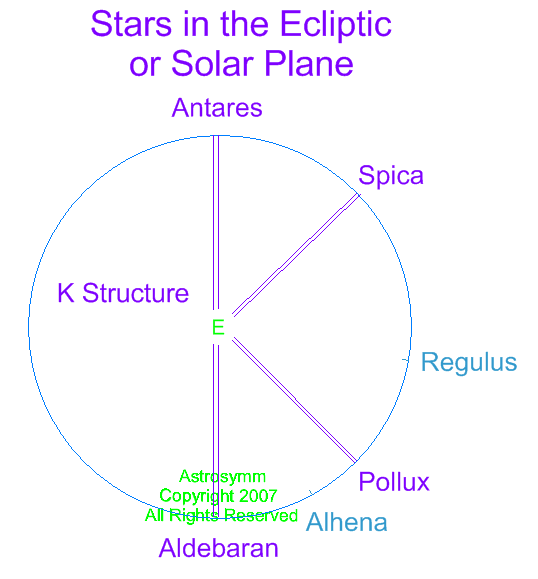
The sun-earth plane is referred as the ecliptic plane. It could also be considered as a broad and thick pancake. The sun, moon and planets regularly align with stars within this plane. They also make symmetric patterns with the ecliptic stars. It’s important to note the “K” pattern composed of the Antares-Aldebaran backbone and Spica and Pollux as the legs.

USGS Photo - Kilauea East Rift 1972

NOVARUPTA
This major eruption occurred in Alaska over 3 days from June 6-8, 1912. During this time Venus and Jupiter were aligned along the Antares-Aldebaran axis and the Sun and Saturn were symmetrically offset from the stellar axis about 9-12 degrees each!
Keywords
Kilauea Eruptions show Uranus 84-Year repeat pattern!
|